Can be produced in shorter time even though fermented bread with yeast is used.
White bread with high quality can be produced as dough is irradiated by microwave.
Darkening can be easily obtained when combined with an outer heater.
Bread crumb can be produced continuously since a continuous dough extruder is used.
Therefore, there is no loss of dough nor waste of installation space.
It doesn't require time nor labour for case maintenance.
Heat efficiency is increased. Entrance of foreign material is reduced.
Products are irradiated on a sanitary conveyor.
Grain can be adjusted freely by setting line.
Required products can be produced without changing line arrangement,
recipe or production method.
Bread produced by Microwave method is small and thin compared with bread made
by the conventional method, and it takes less time for cooling or aging.
Bread crumb can be produced within the day.
Disadvantage of conventional method
Baking method
Dough is put into large case with several kg and burnt. Therefore:
Handling and storage is troublesome due to large case.
Not suitable for users requires all white bread crumb because the crust is coloured.
Peeling crust takes a long time and labour and retention is not good.
It takes a long time for cooling or aging because a large volume of bread is produced.
Foreign materials may enter.
Cost for maintaining cases or for regular replacement is increased.
Electrode method
Larger case is used and heat is added by electrode plates. Therefore:
Handling is more troublesome.
Foreign materials may enter.
It takes longer time for cooling or aging because a large volume of bread is produced.
A number of bacteria are still alive even after being treated by the electrode method.
Insufficient heating results in some parts due to its large volume.
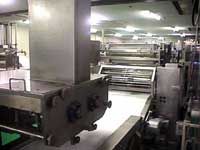
Dough Extruder & Vibrating Roller Unit
Dough Extruder
Dough for bread crumb with even thickness and width are extruded.
Performance can be altered in accordance with rotation speed or length of rotor.
In case of rotor with 14 inches, dough width 400mm X thickness 30mm
Dough extruded from Dough Extruder is sent to Sheeter.
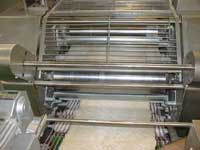
Vibrating Roller Unit
Upper roller moves up and down. Dough is sheeted by light pressure.
(Speed of up and down and spacing between rollers are adjustable.)
Dough can be sheeted ideally without imparting stress.
Final Proofer
Final Proofer
Various units can be arranged to satisfy your needs such as multi-tiered conveyor type
for continuous flowing dough or batch type.
Conventional fermentation is carried out at 38 - 40 degrees centigrade with humidity over 80 for approx. 40 min.
However, fermentation condition depends upon required state of bread crumb.
Single conveyor type (when short fermentation time)
Multi-tiered conveyor or various type conveyors are available.
Microwave Oven
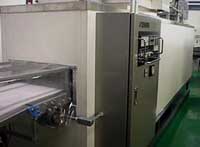
Microwave Oven Model MWC
Irradiated by microwave (2450MHz)
Crust is not coloured and even white bread can be obtained.
Belt width of microwave oven is determined according to dough width and number of line.
Output of machine is max. 200Kw, standard.
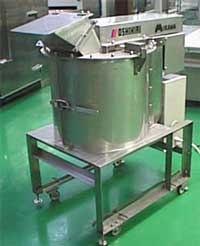
Grinder
Mikawa Denki Works. Co., Ltd. Grinder
The material to be ground is inserted, roughly ground and mixed over the rotary drum.
It is then cut with the cutter on the side,
ground and then discharged instantaneously through the set meal net according to the mesh dimensions.
Low frictional heat is grenerated in the material to be ground.
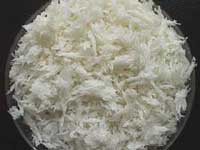
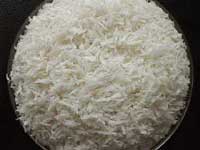
Pictures of Bread Crumb
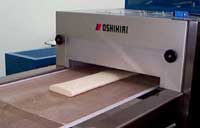
These are the pictures of products irradiated by microwave.
*
Condition of products (needle shape) depends upon proofing time and the state of stretch before microwave irradiation.